GTA 6 traffic tech: the patent and leaked file behind smarter NPCs

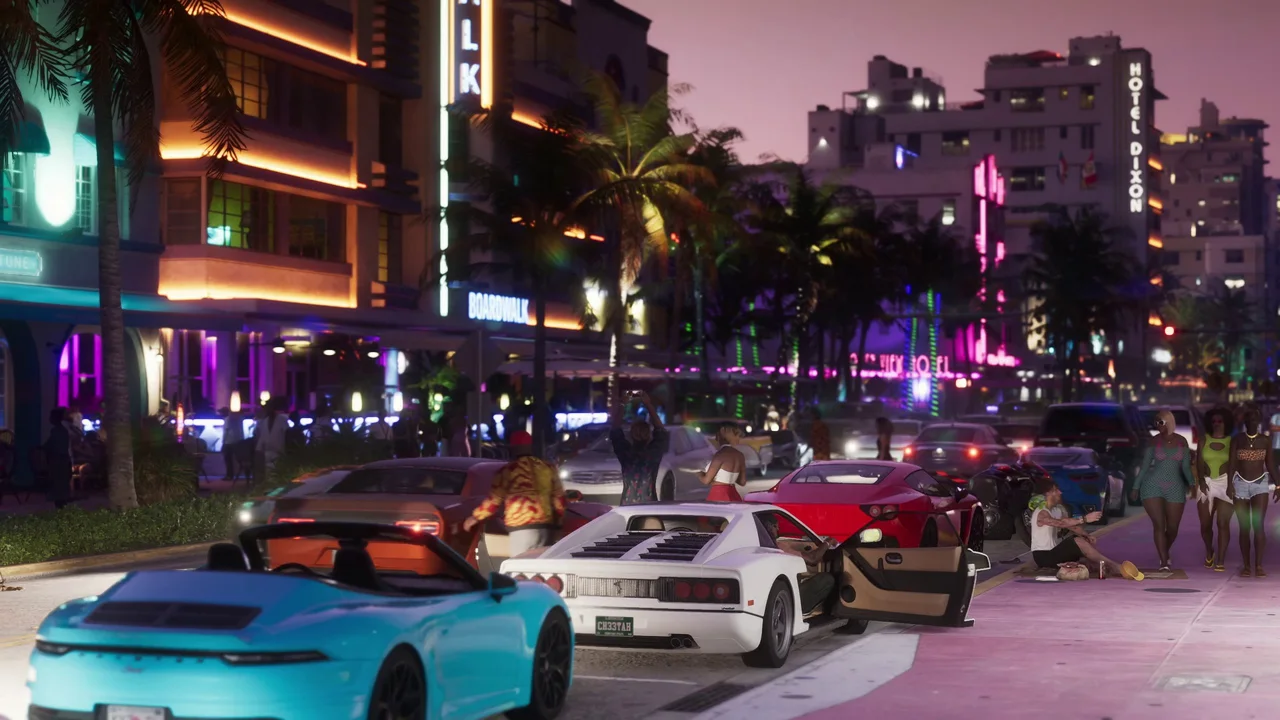
Watch the GTA 6 trailers with the traffic in mind and one thing jumps out: the cars barely repeat. Where older Grand Theft Auto games lined up the same three sedans down a block, Vice City rolls past in sedans, compacts, pickups, sports cars and delivery vans that mostly look like individuals. Players noticed, and it fed straight into the wider list of new mechanics people are tracking, along with the obvious question: how is a console supposed to hold all of that, and does it survive the moment you turn the camera away?
What is actually behind GTA 6's traffic?
Three things, and only one of them is guesswork. Rockstar's parent company holds a real, public patent that describes exactly this kind of traffic. The 2022 leak contained a system file whose name matches that patent. And the console hardware, specifically the SSD, removes the old reason traffic had to repeat. Rockstar has confirmed none of the engine details officially, so the split is simple: the direction is documented, the specifics are not.
How GTA 5 built traffic, and why it repeated
GTA 5 ran traffic on a node network. Invisible nodes laid over the roads stored the rules of each stretch: the speed limit, the lane width, the road type and how many lanes there were. NPC cars followed those nodes like rails, and at junctions they mostly chose at random, reacting only to whatever was directly in front of them.
The bigger limit was memory. The engine kept a small pool of vehicle models loaded at any moment and recycled them, which is the real reason you saw rows of identical cars, and why a car could vanish the instant it left your view. That despawn-on-look-away behaviour is baked deep into GTA 4 and GTA 5. It was never a bug, it was how the game stayed inside its memory budget.
The Take-Two patent that names the problem
The strongest evidence is not a leak at all. In October 2020, Take-Two Interactive published a patent titled "A Method for Virtual Navigation in a Gaming Environment", credited to two Rockstar North leads: technology director David Hynd and AI lead Simon Parr. It is a public document, and it reads like a direct answer to the two complaints above.
The patent states plainly that conventional systems only have the resources to automate "a predetermined number of NPC controlled cars", limited by processing power and memory, and that NPCs "are often grouped by characteristics and perform the same motions" and "fade out of existence as the player approaches". Rockstar wrote down the exact problems, too few distinct cars and vehicles popping away, then patented the way around them.
The method describes NPCs that read the type of road and behave accordingly, driving slower on residential streets or making room on single-lane roads; traffic that thins and thickens by area, with main streets carrying more distinct vehicles than side streets; and chase logic that plans routes from the gaps between cars, their relative direction and their difference in speed.
- Navigation: GTA 5's node system follows preset road nodes; the patented "Virtual Navigation" reads the road type and plans a route.
- Junctions: mostly random choices in GTA 5; decisions by traffic flow and conditions under the patent.
- Vehicle count: capped by the memory pool in GTA 5; the patent aims past the "predetermined number".
- Off-screen cars: despawn to save memory in GTA 5; the patent targets that "fade out" behaviour.
- Density: roughly uniform in GTA 5; under the patent, main roads run busier than side roads.
What the 2022 leak adds
The September 2022 leak, the 90 development clips Rockstar confirmed as genuine the next day, is the part that has to be attributed rather than stated as fact. Data miners reported a file inside the game's World Events named Virtual Navigation, the same phrase as the patent title. According to that leaked material, NPC drivers would make real-time decisions from the city's traffic flow, road conditions and the vehicle they are in: changing lanes before a highway exit, easing off in residential zones, and taking an alternative route instead of blindly following a node.
Treat the leak as what it is, a look at 2022 development code, not a promise about the finished game. What makes it worth mentioning is the overlap: a public patent and a leaked file, from different years and different sources, point at the same named system.
Can a console actually hold all those models?
This is where the common guess, that the variety must be a PC-only feature because it is too heavy on RAM, gets the bottleneck wrong. The PS5 and Xbox Series X both carry 16 GB of shared memory, and that number alone was never going to explain a leap in traffic. The part that changed is storage speed. The PS5's SSD moves data at around 5.5 GB/s, and both consoles can stream assets in and out fast enough that the engine no longer has to keep everything it might need sitting in memory.
That is the quiet fix. When you can pull a fresh, unique model off the drive in a fraction of a second, the small cache of a dozen models that forced older games to repeat stops being the wall. Variety in traffic is now a streaming problem, and streaming is exactly what this console generation was built around. It is not a reason to assume the density is reserved for a PC version that has not even been dated.
What the trailers actually show
Beyond the sheer count of models, players picked out specific behaviour in the official footage. AI bikers pull into the oncoming lane to overtake a slow truck, and position themselves to see the road first, rather than sitting in a line as if on tracks. It is a small clip, and the fair caveat is that a trailer moment could be a scripted setup rather than proof of the live system. Still, it matches what the patent and the leaked file describe, which is why it is worth more than a normal trailer detail.
Ignore the "RAGE 9" spec sheets
Search the topic and you hit a wall of articles confidently breaking down the "RAGE 9 engine", complete with driver personality traits, ocean physics and even a "technical review" written as if the game were already out. GTA 6 is not out, nobody has driven its traffic, and "RAGE 9" is a community nickname, not a name Rockstar has ever confirmed for the engine. Most of those spec sheets are invented. The parts that hold up are the boring, checkable ones: the patent document and the leaked file. Anything dressed up as a finished-game review is filler.
What is still unknown
Plenty. Nobody outside Rockstar knows whether cars will still despawn behind you, only that the patent explicitly targets that behaviour. Nobody knows the real number of distinct models in traffic, or whether the launch build will hold the density seen in the first trailer, which is a community hope drawn from patents and Red Dead Redemption 2, not a statement from Rockstar. And the idea the community keeps floating, a rare classic that spawns once on the entire map, is exactly that: a wish, not a feature. When GTA 6 arrives on 19 November 2026, the traffic is the first thing worth testing against all of it. The same leaked directory that held the traffic file is the one behind the 1,367 world events people keep quoting.